
A balanced framework for comparing one more repair with a planned furnace or boiler replacement.
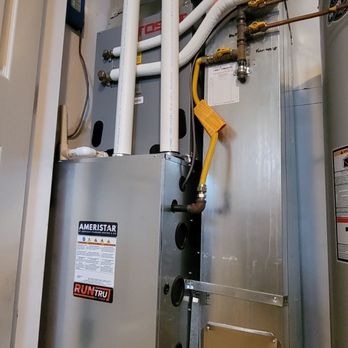
Representative High Demand Heating project photo. The customer address and exact project location are intentionally omitted for privacy.
Begin with a specific diagnosis
You cannot compare repair and replacement fairly until you know what failed. Ask for the cause, the proposed repair and whether the technician observed other significant wear or safety concerns. A small control repair on an otherwise sound system is different from a major failure on equipment with a history of breakdowns.
Also ask what the repair does not address. A repaired component may restore operation without improving existing noise, comfort, airflow or energy concerns.
Look at age and repair history together
Older equipment is not automatically beyond repair, and newer equipment is not automatically economical to fix. Age becomes more meaningful when combined with part availability, repeated service calls, corrosion, heat-exchanger or vessel condition and the expected remaining service life.
Review what you have spent recently and whether the same underlying issue keeps returning. Several unrelated minor repairs may still be manageable; repeated major work can make planned replacement more predictable.
Consider comfort, safety and the complete system
Uneven temperatures, poor airflow, persistent noise or rooms that never become comfortable may involve the distribution system or building—not only the furnace or boiler. Replacement equipment should be selected with those conditions in mind rather than expected to solve every problem by itself.
Confirmed safety defects need prompt attention. Do not continue operating fuel-burning equipment when a qualified professional has identified an unsafe condition.
Compare the real scope and ownership horizon
A replacement estimate should include required venting, piping, drainage, controls, electrical work, removal, permits where applicable and commissioning. Compare warranty and maintenance requirements along with the equipment price.
If you expect to remain in the property, comfort and long-term reliability may carry more weight. If you need a safe short-term solution, a repair may be reasonable when the diagnosis supports it. High Demand Heating can explain both paths before work proceeds.